Explanation of the process of generating, recording, and submitting invoices, ensuring their integrity, traceability, and compliance with Spanish Tax Agency regulations.
GCON4 – Global Unit4 Partner for Unit4 Business Enterprise solutions

Our solution ensures legal compliance, automates processes, and facilitates accounting and tax management fully aligned with the AEAT.
Verifactu is a system created by the Spanish Tax Agency (AEAT) to control and certify invoicing software. Its objective is to prevent tax fraud by ensuring that companies cannot modify or delete issued invoices without leaving a trace.
Verifactu does not directly apply to companies or self-employed professionals, but rather to certified invoicing software. Companies and self-employed professionals using compliant software may voluntarily choose to send their invoices to the AEAT through Verifactu, except in specific cases where the regulations require it.
Verifactu allows you to:
Automatically send invoices to the Tax Agency securely.
Ensure that data is complete, traceable, and tamper-proof.
Reduce tax fraud and guarantee the authenticity of invoices.
Facilitate the verification of electronic invoices and streamline administrative procedures.
According to the regulation approved in 2025:
Invoicing software must comply with the requirements before July 29, 2025.
Large companies subject to Corporate Income Tax have until January 1, 2027.
Self-employed professionals, SMEs, and other entities have until July 1, 2027 to adapt.
Explanation of the process of generating, recording, and submitting invoices, ensuring their integrity, traceability, and compliance with Spanish Tax Agency regulations.
Any software that generates invoices must send a record of each invoice to the Spanish Tax Agency.
Once sent, the invoice receives a unique code and a timestamp that certify it has been registered.
This ensures that the invoices are tamper-proof and verifiable.
Summary of key dates and transition periods to adapt your processes and systems to Verifactu regulations, ensuring compliance within the deadlines set by the Spanish Tax Agency.
Publication of the Ministerial Order
The Ministerial Order HAC/1177/2024 is published, establishing the technical requirements for the Verifactu system.
Real Decree 254/2025
The regulation establishing the requirements for invoicing software is approved.
Adaptation by Software Developers
Deadline for developers and invoicing software providers (SIF) to adapt their programs.
Obligation for companies with annual revenue exceeding 8 million euros
Companies subject to Corporate Income Tax must issue invoices using certified software in accordance with Verifactu.
Obligation for self-employed professionals and other practitioners
Self-employed professionals, companies, and other taxpayers must comply with the Verifactu regulations.
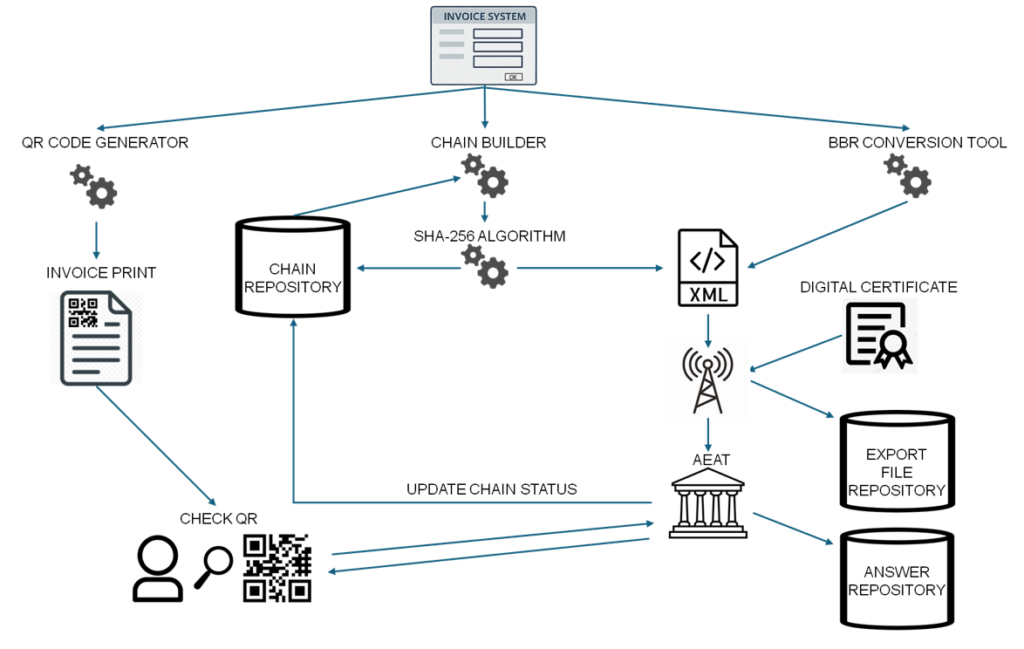
High-level view of the components, flows, and integrations that make up the solution, showing how the systems connect to ensure Verifactu compliance.
Summary of the regulatory obligations and technical specifications required to comply with Verifactu and the Spanish Tax Agency.
| Legal Requirement | Implementation in Unit4 ERP | Technical Notes |
|---|---|---|
| Record Integrity | Electronic records are automatically generated for each issued invoice in accordance with the regulations. | BBR conversion tools are used to collect invoice records and transform them into XML files. |
| Inmutability | Neither invoices nor electronic records can be modified once they are generated. | Unit4 ERP does not allow posted invoices to be modified. Electronic records cannot be modified either. |
| Traceability | Invoice records are stored sequentially in creation order, including a digital fingerprint that references the fingerprint of the previous invoice. | The SHA-256 algorithm is used to encode digital fingerprints. The chaining is stored in a read-only table. |
| Automatic Submission to the AEAT | Automated API Integration | Web services are called automatically to report invoice records. |
| Authentication with Digital Certificate | The digital certificate is used to authenticate the user or company when reporting invoice records. | Certificate management allows each authorized user to be granted access to use the certificates available in the system. |
| Accessibility and Readability | All export files and AEAT responses are available. | The AGRESSO_EXPORT folder is used to store XML files. |
| QR Code | Each issued invoice includes a printed QR code. This code contains a URL that allows verification that the invoice has been reported to the AEAT. | The URL contains the following fields: From acrclient • nif: vat_reg_no From acutrans • Numserie: ext_inv_ref • Fecha: voucher_date • Importe: cur_amount |
GCON4 MFL is the ultimate solution when it comes to data migration and management in Unit4 ERP. It is an indispensable tool that offers exceptional benefits that cannot be overlooked. With GCON4 MFL, you can streamline the migration process significantly and reduce the time spent on it so that you can focus on other critical tasks.

Engineering projects are becoming more complex. Tighter deadlines, increasing regulatory requirements, talent shortages, and rising costs are putting pressure on

Unit4 ERP is a great fit for engineering companies due to its flexibility and ability to manage complex projects, resources,

The future of ERP (Enterprise Resource Planning) technologies in professional services is likely to be shaped by several key trends